
Industry Trends
Why Smart Leaders Still Get Inconsistent Results (and What Kolbe Reveals About It)

Karen Powell, Certified Kolbe Consultant
Brian Miller, Business Strategist
The Frustration Smart Leaders Rarely Admit
 We all do it. We hire high performers, assemble what we think are capable teams, and boom, expect miracles. When it doesn’t happen, we can’t help but think we’ve made a mistake. What could we have done wrong? We hired the best and brightest and assembled an amazing team! Expectations are missed, follow-through is inconsistent, and we make assumptions.
- “I wasn’t clear enough.”
- “They didn’t own it.”
- “We must demand more accountability.”
News Flash: Leaders communicate and delegate based on how they take action. Have you ever thought this-asking for a friend 😉: “If it makes sense to me, why doesn’t it make sense to them?” Come on, admit it. You know you have. But here’s the thing– Competence is rarely the issue. Instinct mismatch often is.
So then “spinning” occurs. In other words, results fail to materialize. We execute on the wrong things. So what do we do as leaders? We overcompensate. We must be clearer. We’re compelled to be more “firm.” We insist on accountability. But re-explaining and demanding more accountability alone do not solve the problem. More detail does not guarantee better execution. More structure does not work for everyone, and neither does more freedom. In response, leaders repeat themselves, over-specify, and either unintentionally or intentionally micromanage. The real issue is often not how effective your communication style is, but a mismatch between how something is communicated and how a person naturally takes action.
Kolbe’s Insight: People Take Action in Predictable, Different Ways
 And that brings us to the Kolbe Wisdom™. Kathy Kolbe teaches that people do their best work when they are allowed to operate in alignment with how they are naturally wired to act. When leaders honor those instincts rather than fight them, execution becomes cleaner, energy goes up, and results become far more consistent.
Kolbe focuses on conation—the instinctive way people operate when striving to solve problems and/or achieve results.
The four Action Modes describe how individuals naturally take action and solve problems. Let’s take this one step deeper.
Within each Action Mode, there are three ways (or zones) in which people operate. Those scoring in the 7–10 range initiate action in that mode. They instinctively lead with that method.
Those in the 4–6 range ReAct. They can use that mode effectively when needed, but it is not their natural starting point.
Those in the 1–3 range CounterAct. They tend to resist that approach and will find alternative ways to solve the problem.
Understanding this helps us see not just what someone can do, but how they are naturally wired to take action. However, a key takeaway is that we all possess strengths in each action mode.
- Fact Finder – Methods of gathering and sharing information. Someone who initiates in Fact Finder is the researcher, gathering and analyzing data before making decisions. Initiating Fact Finders ask many questions, seek detailed information, and ensure informed decision-making. In a franchise system, this strength supports compliance, structure, and long-term strategic planning. However, if you look at the attached exhibit, Kolbe Strengths™, you will also see ReAct and CounterAct zones. (It may be helpful to refer to the chart as you read this section.) Someone who may not initiate in Fact Finder but ReActs would be able to “explain” things well, paraphrase reports, fact-check, and highlight what’s important. Conversely, someone who CounterActs in Fact Finder still has strengths in this Action Mode; however, they are more along the lines of “simplifying.” They may “capture the essence” of a project or plan.
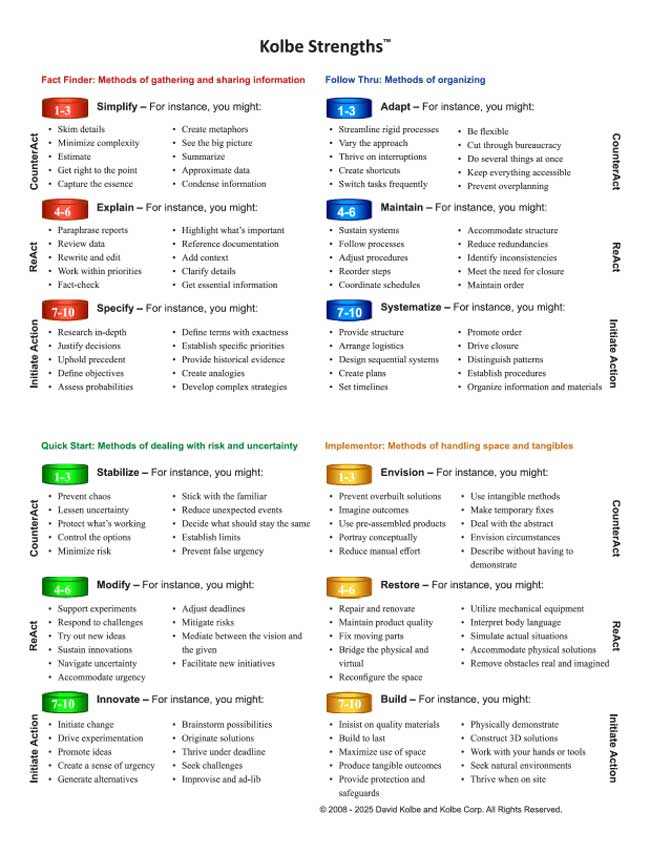 Follow Thru – Methods of organizing. We all probably know people who are really good at follow-through. They are the organizers, people who create and maintain systems, structures, and processes. People who initiate the Follow-Through systematize. Initiating Follow-Thru leaders provide structure, arrange logistics, promote order, etc.Initiating Follow-Through leaders also provide consistency, which is vital for franchise operations, training, and maintaining brand standards. However, if you are in the ReAct zone of Follow-Thru, you “maintain” and are great at sustaining systems and following processes. Even someone who CounterActs will adapt and can streamline rigid processes and be flexible. Can you see how you may have strengths in an Action Mode, even if you don’t initiate in that mode?
 - Quick Start – Methods of dealing with risk and uncertainty. An Initiating Quick Start is a risk-taker and can be an entrepreneur who thrives on new ideas, innovation, and execution. Many (although not all) franchise founders are Initiating Quick Starts—visionaries who drive the brand’s initial success but often struggle with operational consistency. However, if I ReAct in Quick Start, I may have strengths in “modification.” This person would respond well to challenges and be open to trying new ideas. Conversely, someone with a score in the 1-3 Zone in Quick Start, i.e., CounterAct, is a “stabilizer.” They may establish limits, minimize risk and prevent chaos.
- Implementor – Methods of handling space and tangibles. You probably know someone who is really good at building things. Someone who Initiates in Implementor mode could be a builder, focusing on hands-on solutions, physical space, and tangible application. Initiating Implementors are essential for designing and upgrading franchise locations, improving workflows, and supporting operational excellence. However, someone in the 4-6 zone, ReAct, is a “restorer.” They can repair and renovate, fix moving parts, and still have strong skills in the Implementor Action Mode. Someone who “envisions,” which is zone 1-3, CounterAct, will help prevent overbuilt solutions, imagine outcomes, reconfigure, and remove obstacles both real and imagined.
You can probably see that when your leadership team is made up of an overabundance of one type, you get “spinning” which KOLBE refers to as conative cloning. Good intentions don’t translate to execution. Misalignment shows up as delays, confusion, or things just stall.
 This is why Kolbe encourages organizations, when hiring, to look beyond only the Initiating MO. MO, which stands for method of operation, refers to your instinctive way of taking action when you are free to be yourself. While it is important to have balance among the Initiating MOs, especially on a leadership or management team, true team balance comes from understanding how people contribute across all three zones: Initiate, ReAct, and CounterAct.
What This Means for Executive Communication and Delegation
So how do you avoid getting into the endless “spinning” cycle also known as conative cloning? You share the same goal, but there are different paths to execution. You delegate based on how people naturally act. When you ask someone who leads with Quick Start to act like someone who leads with Follow Through, problems occur. Picture an executive team focused on launching a new growth initiative in 90 days. Everyone agrees on the goal, but friction shows up in how to get there. The CFO leads with Follow Through and wants structure, sequencing, and clear direction before moving. The Head of Sales leads with Quick Start and wants to test ideas, learn fast, and adjust on the fly.
As Karen Powell puts it, “We experienced the same thing in our organization. We were in synch on goals, but we kept “spinning.” Once we learned Kolbe and really understood how people take action, things started to move. We stopped asking people to work against their instincts, and everything got clearer.”
That’s really the shift. When delegation aligns with conation, progress replaces stalling. Give the Sales leader the freedom to run fast pilots. Let the CFO turn what works into a repeatable process with guardrails. Same goal. Different paths. You stop chasing outcomes and results happen!
Leading Across Instincts Changes Results Without Changing People
 Do More, More Naturally by David Kolbe and Amy Bruske reinforces a simple but powerful idea: people perform at their best when they work the way they are naturally wired to take action. The book is a guide for leaders on how to unlock stronger execution across their executive teams via understanding conation, the instinctive part of the mind. Frustration, burnout, and blocked progress often arise when leaders ask people to work against how they naturally operate. When people are allowed to execute in ways that match their instincts, the spinning stops, and results improve without added pressure from leaders or increased frustration on the executive.
So how do you fix it?
Maybe your organization is experiencing something similar. Are you missing deadlines or showing inconsistent follow-through? Is it really a performance issue, or are people being asked to take action in ways that go against how they naturally behave?
You do not fix it by replacing people. Most leadership teams do not have a talent problem; they have an alignment problem. A smart place to start is for leaders to take the Kolbe A Index to understand how each person naturally takes action. That clarity quickly reveals where execution gaps exist, not because people are failing, but because certain instincts may be missing or underrepresented on the team. Understanding your Leadership Team first is essential to avoiding the “spinning cycle” or “conative cloning.” Once you have a clear picture of the Leadership Team, a great idea is to give the Kolbe A to the rest of your entire team, and certainly at a minimum to anyone in management. When you administer Kolbe to an entire management team, or franchise support team, you can build a distribution chart and create a Team Success Profile that visually shows where people cluster and where gaps exist.
From there, leaders have real options. You may decide to add someone to one of the teams who brings a different approach to action. Or you may pair a leader with a manager whose instincts complement theirs, someone who naturally stabilizes, sequences, or accelerates execution. The goal is not to change people. The goal is to build coverage across how work actually gets done. When leadership teams are designed this way, execution improves without turnover, pressure, or frustration.
Better leadership is not louder or tighter, it is more aligned.